
Voting
- Details
- Category: Voting
How-to-vote cards (HTV) are prepared by a party, group or independent candidate.
They indicate how they want you to record your preferences when voting.
It is up to you whether you follow a HTV card or mark your ballot papers according to your own choices.
There are 2 types of HTV cards:
- A HTV card lodged with the Electoral Commission of South Australia for display in polling booths and early voting centres.
- A HTV card lodged with the Electoral Commission of South Australia by a person who intends to distribute the card during the election period.
Political party and candidate workers
Political party and candidate workers may be outside polling places with HTV cards showing you how they would like you to vote for their candidate.
You do not have to take these if you don't want to.
A person must not distribute a HTV card during the election period unless it is substantially the same as a card lodged for display in polling booths or lodged with Electoral Commission of South Australia.
- Details
- Category: Voting
The way to complete your ballot papers is different at each type of election in South Australia. On this page you can find instructions on how to complete your ballot paper correctly at each election.
State elections and by-elections
When voting in a state election you will be given 2 ballot papers: a small green paper for the House of Assembly, and a large white paper for the Legislative Council. At a by-election, you will just be given a green House of Assembly ballot paper.
House of Assembly
On the green House of Assembly ballot paper, you need to number every square in the order of your choice.
- Write the number 1 in the square next to the candidate who is your first choice
- Write the number 2 next to your second choice
- Continue by placing the numbers 3, 4, 5 and so on until you have a number in every square.
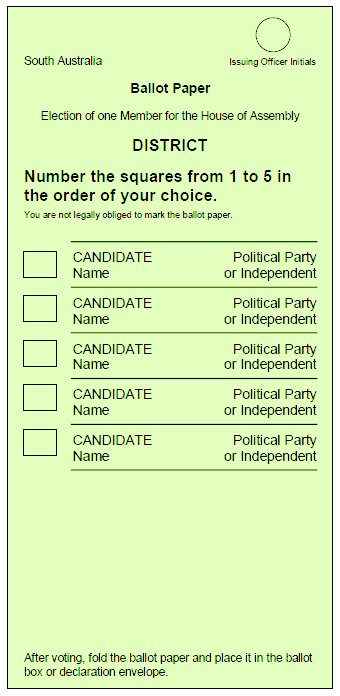
If you need assistance or make a mistake please see an electoral officer.
You can practice making a formal vote by using our interactive ballot paper below:
House of Assembly practice ballot paper >>
Legislative Council
On the white Legislative Council ballot paper, there are 2 ways you can vote. Either above the red line or below the line - but not both.
Vote above the red line:
If you choose to vote above the red line:
- Write the number 1 in the square next to the party or group of candidates which is your first choice.
- You can then write the number 2 next to your second choice, and so on for as many parties or groups of candidates as you like. You do not need to number every square.
- Leave the rest of the ballot paper blank. Do not mark below the red line.
By voting above the red line, your vote will go to the candidates within the group (or groups) you have chosen.
Vote below the red line:
If you choose to vote below the red line:
- Write the number 1 in the square next to the candidate who is your first choice.
- Continue by placing the numbers 2, 3, 4, 5, 6 in the squares next to the other candidates of your choice until you have chosen a minimum of 12 candidates.
- You may choose to continue numbering more than 12 candidates.
By voting below the red line, you are deciding the order of candidates according to your preferences.

If you make a mistake, don't worry. Put a line through the mistake and write the correct information beside it, or you can ask an electoral officer for a replacement ballot paper.
You can practice making a formal vote by using our interactive ballot paper below:
Legislative Council practice ballot paper >>
First Nations Voice elections
When voting at a First Nations Voice election you will be given a ballot paper showing all the candidates for your region.
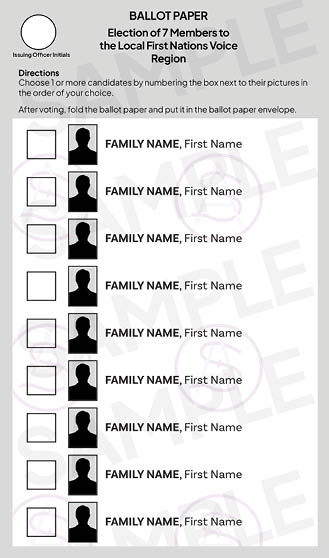
To vote, you must write a number 1 in the box next to the name and photo of the candidate who is your first choice.
If you want to, you can vote for more candidates. Write the number 2 in the box next to the candidate who is your second choice, the number 3 in the box next to the candidate who is your third choice and so on.
Continue on until you have voted for all the candidates you want to.
You don’t have to number every box.
Remember, it’s your choice how many candidates you vote for.
You don’t have to vote for more than 1 candidate, but your Local First Nations Voice will have 7 or 11 elected representatives, so it is a good idea to vote for multiple candidates to represent you.
If you only vote 1, your vote can only help 1 candidate to get elected. The more candidates you vote for, the more you can help your preferred candidates get elected.
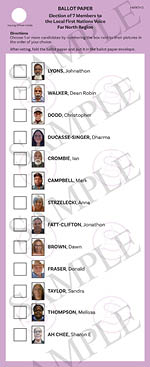
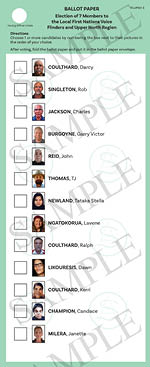
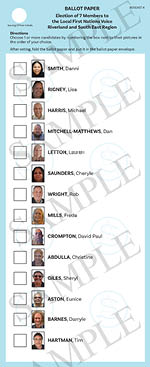
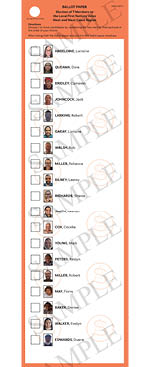
To view and download a copy of the 2024 Local First Nations Voice election ballot papers, click on the pictures below.
| Sample ballot papers | ||
|
Central
|
Far North
|
Flinders & Upper North
|
|
Riverland & South East
|
West & West Coast
|
Yorke & Mid-North
|


More information
Download a copy of our easy read guide on voting at state elections (PDF, 1.5MB)
Download a copy of our easy read guide on voting in a by-election (PDF 2.64MB)
- Details
- Category: Voting
South Australian voters choose representatives to make decisions on their behalf at elections.
Decisions made by these representatives and other elected members affect almost every aspect of our daily lives.
This section of our website will help people understand how the South Australian voting systems work and the rights and responsibilities of voters.
The list below has some of the responsibilities of each level of government.
Federal government (compulsory voting):
- Defence
- Immigration
- Social services
- Higher education
- Medicare and health funding
- Taxation
State government (compulsory voting):
- Law and order
- Schools and education
- Hospitals and health services
- Roads and highways
- Transport
- Housing
Local council (non compulsory voting):
- Local roads and footpaths
- Libraries
- Child care centres
- Recycling and waste management
- Sporting facilities and recreation reserves
- Town planning and building regulations
Your vote is important and all votes are equal.
Where you can follow us





- Details
- Category: Voting
A proportional representation system of voting called single transferable vote is used to elect members of the Legislative Council. This system has been used in South Australia since 1975.
In order to win a seat in the Legislative Council, a candidate is normally required to obtain a ‘quota’ of the formal votes. This quota - or minimum number of votes required to win a seat – ensures that winning candidates are elected with a near equal numbers of votes.
Counting the votes for the Legislative Council is both slower and more complicated than the count for the House of Assembly. On election night only first preferences are counted, leaving the major part of the count – i.e. the calculation of the quota, the distribution of surplus votes and the exclusion of candidates - to the days after the election.
Five steps are followed to count the votes for the Legislative Council:
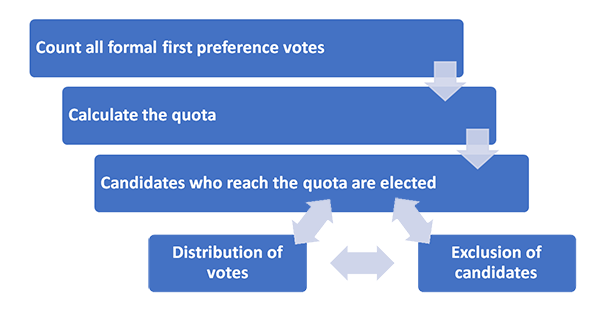
A detailed explanation of the steps involved can be found below.
1. Counting the first preference votes
The first step in the process is to sort the ballot papers into first preferences for each group above the line and below the line, as well as first preferences for each ungrouped candidate. The first preference figures are then transmitted to the media and published on the ECSA website.
Once all declaration votes have come in from across the state and around the world – which cannot take place until the final postal votes have been received seven days after polling day - the total number of formal (or valid) votes can be calculated. This number is essential for the second step in the process, calculating the quota.
2. Calculating the quota
To be elected to the Legislative Council, candidates need to gain a minimum number – known as a quota - of the total formal votes. This quota is calculated by dividing the total number of formal ballot papers by one more than the number of Legislative Council members to be elected, and then adding one to the result (disregarding any remainder).

3. Election of candidates who reach the quota
Candidates who receive a total of first preference (or number ‘1’) votes equal to or greater than the quota, are elected immediately.
It is possible, although very unusual, for this to lead to all the vacant seats being filled, and therefore, the election being finalised. It is much more frequent however, for the Electoral Commission to need to move on to the next two steps in the counting process.
4. Distribution of surplus votes
If any elected candidates received more votes than the quota, their surplus votes are distributed to the remaining candidates according to the further preferences indicated on the ballot papers.
Because it is not possible to determine which votes actually elected the candidate and which votes are surplus, all the elected candidate’s ballot papers are transferred at a reduced value called a ‘transfer value’.
The transfer value is calculated as follows:

As surplus votes are distributed, other candidates may be elected. However, if at any point all the surplus votes from elected candidates have been distributed and there are still positions left unfilled, the Electoral Commission proceeds with the next step in the counting process.
5. Exclusion of unsuccessful candidates
Starting with the candidate who received the lowest number of votes, unelected candidates are excluded from the count. The excluded candidate’s ballot papers are distributed to the remaining candidates based on preferences.
If any of the remaining candidates obtain a quota through this process of distribution, they are elected.
Their surplus votes (if any) are distributed before any other candidates are excluded. This process of distributing surplus votes from elected candidates and excluding the candidate with the fewest votes is continued until all vacant Legislative Council seats are filled.
Exhausted ballot papers
As a result of voting reforms before the 2018 State Election, the Legislative Council now has a partial preferential rather than fully preferential voting method. This inevitably leads to an increase in the number of votes that are ‘exhausted’ – i.e. ballot papers where no further preferences have been expressed. Once a vote has been ‘exhausted’, it must be set aside from the count.
Candidates elected without a quota
If, as a result of exhausted ballot papers, there are not enough votes left in the count to fill the remaining vacant seats, the candidate or candidates with the highest number of votes are elected regardless of whether they have reached the quota.